MLCIPR 2025
The 2025 2nd International Conference on Machine Learning, Computational Intelligence and Pattern Recognition (MLCIPR 2025), jointly organized by Hohai University and Nanjing Tech University, has successfully concluded from December 19 to 21, 2025 in Nanjing, China. This conference, through a combination of online and offline methods, gathered about 100 experts, scholars, researchers, and industry professionals from home and abroad to jointly explore the cutting-edge progress, innovative applications, and future trends in the fields of machine learning, computational intelligence, and pattern recognition.

At the opening ceremony of the conference, as representatives of the organizers, Professor Fan Liu, Vice Dean of the College of Computer Science and Software Engineering at Hohai University, and Professor Cuimei Bo, Vice Dean of the College of Electrical Engineering and Control Science at Nanjing Tech University, delivered welcoming speeches to the guests and emphasized the importance of strengthening international academic exchanges and cooperation in promoting innovation and development in the field in the context of the rapid development of artificial intelligence technology. Th conference was opened by Professor Bin Tang, Vice Dean of the College of Computer Science and Software Engineering at Hohai University.


This conference invited several well-known domestic and foreign experts as keynote speakers, sharing their latest research results and profound insights.
Prof. Cuimei Bo, Nanjing Tech University, China |
Prof. Keyang Cheng, Jiangsu University, China |
Prof. Longxiang Gao, Qilu University of Technology (Shandong Academy of Sciences), China |
Prof. Zehui Mao, Nanjing University of Aeronautics and Astronautics, China |
Assoc. Prof. Guo Yu, Nanjing Tech University, China |
Assoc. Prof. Ata Jahangir Moshayedi, Jiangxi University of Science and Technology, China |


There are also 18 exciting oral presentations and over 10 poster displays in the conference, with participants engaging in in-depth exchanges and lively discussions on multiple dimensions such as algorithm innovation, theoretical breakthroughs, and technological applications.

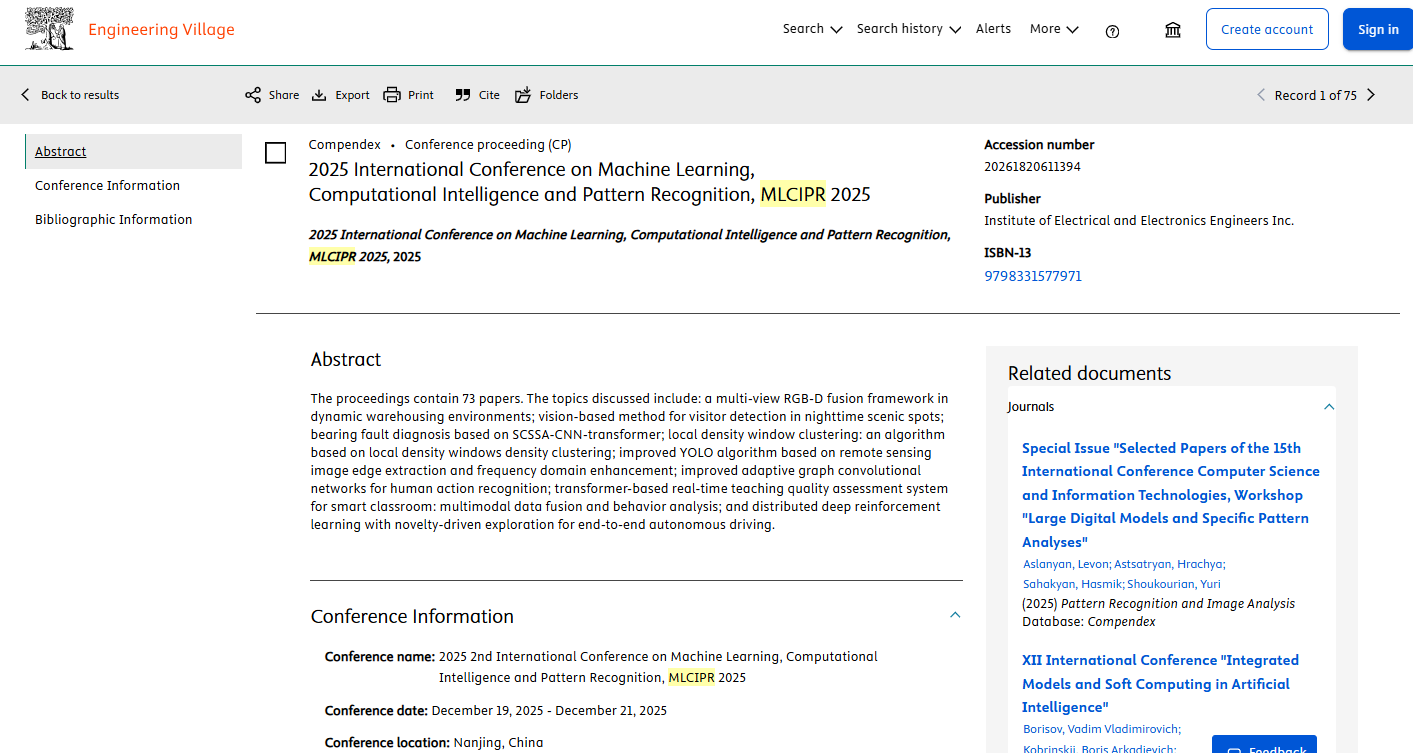
All accepted papers of MLCIPR 2025 has been published in the conference proceedings by IEEE and has been indexed by EI Compendex, Scopus.
Conference proceedings:https://ieeexplore.ieee.org/xpl/conhome/11406209/proceeding